Nature does not create identical, perfect surfaces. Hidden within the interrupted veining, the color variations, and the mineral inclusions of natural stone lies a characteristic that no industrial process can reproduce exactly: uniqueness.
In marble, what may seem like an imperfection at first glance is often precisely what gives the material its character. An irregular pattern, an unexpected shade, or a vein that crosses the surface without following a predictable pattern can transform a slab into a one-of-a-kind element, capable of becoming the visual focal point of a project.
For architects and interior designers, learning to interpret these characteristics means expanding the expressive possibilities of natural stone.

Nature never repeats itself
Every slab of marble is the result of a unique geological process, involving stratification, pressure, and transformations that took place over millions of years. It is this origin that determines its colors, veining, and mineral inclusions. The veining is not merely a superficial decoration: it reflects the complexity of the stone’s structure and the processes that formed it.
This variability isn’t limited to different types of stone: even blocks from the same quarry and identified by the same commercial name can exhibit significant differences. The background color, the intensity of the veining, and the overall pattern can vary considerably, making each block unique.
For this reason, choosing marble means looking beyond the stone’s name and learning to interpret its characteristics, recognizing each variation as a potential design opportunity.

When imperfection becomes character
For a long time, design has prioritized industrial perfection: uniform surfaces, consistent colors, and controlled textures. Today, there is a growing interest in authentic materials—ones that express their origin and make each project unique.
In marble, an unexpected vein, a variation in color, or a mineral inclusion are not necessarily flaws to be corrected, but rather characteristics that contribute to the stone’s identity. It is a beauty distinct from that of mass-produced materials: it seeks not repetition, but uniqueness.

This quality takes on particular significance in high-end residential interiors, where customization is increasingly important. A natural surface can thus become much more than just a finish: it can be a distinctive element capable of lending character to a space and making it one-of-a-kind.
Of course, not every irregularity is merely an aesthetic issue: cracks and other imperfections must also be evaluated from a technical standpoint, depending on the application and the required performance.

Learning to read the material
Choosing a natural stone means looking beyond its commercial name or reference color. It requires observing the material as a whole, evaluating the pattern of its veins, its color nuances, and the character it conveys.
For this reason, the choice of stone is more intuitive than geometric. A slab should not be selected with the expectation of exactly replicating a photograph or a sample, but rather for its overall character and the way it interacts with the space and other materials in the project.
Differences that, when observing a slab up close, may seem decisive often take on a different significance once the stone is processed and incorporated into the architectural context. What matters is not scrutinizing every single vein, but understanding the overall effect and recognizing the characteristics that make that material suitable for the project.
This is where knowledge of the material becomes essential: not to eliminate every variation, but to make an informed choice of stone and highlight its unique identity.

From natural variation to design composition
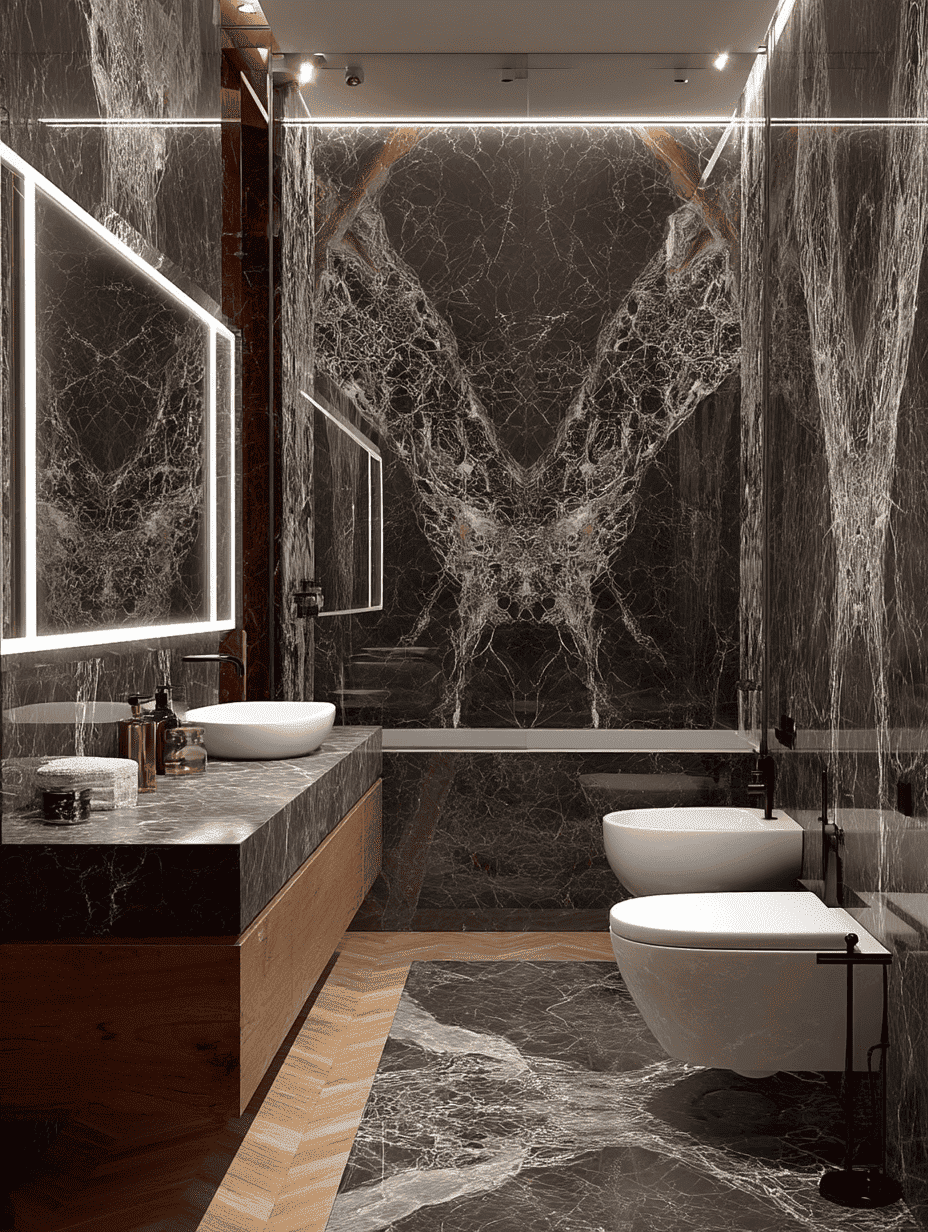
Bringing out the natural characteristics of marble means knowing how to interpret them through design. The arrangement of the veins, the orientation of the cut, and the composition of multiple elements can transform the unique features of a slab into an expressive design choice. Techniques such as bookmatching—which pairs mirror-image slabs to create continuity or symmetry—allow the natural pattern to become an integral part of the architecture.
The processing method also helps define the final result. However, the choice of finish does not always result in a perfectly uniform effect. Depending on the stone’s mineralogical composition and structure, the same processing method can produce different results at various points on the slab, creating variations in surface texture. These differences can also be felt to the touch, through subtle changes in roughness or texture.
These nuances are part of the material’s identity and serve as a reminder that natural stone is not a standardized industrial surface. Its uniqueness is expressed not only through colors and veining, but also through textural characteristics that can vary within a single piece.
The goal is not to eliminate this variability, but to give it direction through design choices and finishing techniques that enhance the stone’s character.

The value of what cannot be replicated
In a context where many materials can be produced according to standards of uniformity and repeatability, natural stone retains a distinctive value: each slab presents a combination of characteristics that cannot be exactly replicated.
This makes the selection process much more than just a choice of color. It means identifying a specific material, understanding its potential, and deciding how to integrate it into the space so that its uniqueness becomes part of the architectural language.
For Pistore Marmi, working with stone also means this: recognizing the value that already exists in the material and connecting it to the designer’s vision. Through material selection, precise craftsmanship, and attention to detail, the stone’s natural characteristics can be enhanced and transformed into custom-made elements.
Because the beauty of marble does not lie in the perfection of a uniform pattern, but in the balance between what nature has created and what the design is capable of making of it.
Each slab tells a unique geological story. Design should not erase it, but find a way to give it form.